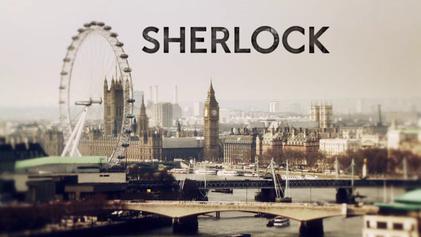
Since everyone is talking about the BBC Sherlock, I might as well hop on the bandwagon.
Warning: Spoilers ahead. Tread with caution.
Also, for the sake of clarity, Sherlock refers to the drama character, Holmes the original canon character. Same goes for John and Watson, respectively.
Suffice to say, it is one of the most brilliant screen adaptations, if not, THE most brilliant screen adaptation of one of the world's most famous fictional sleuth.
With everyone raving stars about it, I turn my thoughts to the criticism I have with the serial.
Of course the show was not perfect. Even the original canon was inconsistent with its own facts. Sir Conan Doyle must have not kept notes about his characters and their characterizations to raise many eyebrows with the continuity errors.
To be honest, I am only nit-picking. The show was all thumbs up and I enjoyed every second of the 90 minute-long episode for all three of the first season. I have not watched the second season. May revisit this post after I have watched them.
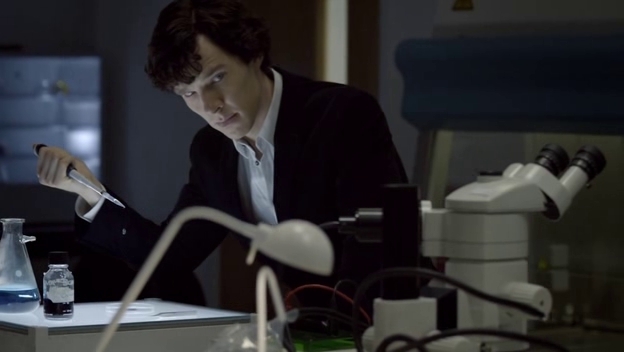
Maybe I should start with my praises for the show.
1. Cinematography and Directing
I think the directing is one of the most splendid done for mystery serials. It is not cheesy, over the top or even achingly dull. The sharp shots, the different point of views, the parallel camerawork and the color and tone of the episodes marked the scenes with its own pacing even without the writing. I appreciate that the dreary tone of London as described by Conan Doyle (or London's tone is really that dull, I have no say in that) is carried across the episodes. Every scene is dogged by a mysterious aura, and the visuals tend to speak its own stories.
2. Writing
Of course, the main rave for the series really lies in the writing. Steven Moffat and Mark Gatiss (who also played Mycroft Holmes), co-creators of the series, really knew how to bring fresh life to a fictional legend that has been adapted to many media. Pacing was substantial (more on that later) and dialogue is quick-witted and sharp. Exactly how the real Holmes would react in most situations. Love the part when Sherlock scolded himself in "The Blind Banker" when he found out that he erred, because it was just like Holmes to chastise himself severely when he made a mistake. And I do like that the dear John Watson is given some smarts but not too much. He is still more humble and more accommodating than Sherlock Holmes himself. I love the juxtaposition of the characters, just as they are in the book.
3. Acting
Ah, Benedict Cumberbatch, you have grown since the last I saw you in Hawkings. You were always memorable because of your unique name. When I found out that you were playing Sherlock, I was excited because I couldn't wait to see you bring life to Holmes. And you played Holmes almost perfectly. Your seeming indifference to human emotion was carefully and skillfully nuanced with your panic when John was in danger. Martin Freeman plays a convincing Watson with some more kickassery in the book, though I always thought Watson to be a heavier man. Hee. Not even dashing Jude Law can change my perception of Watson's build. He carried Watson's easy-to-read emotions well and proved himself to be quite the loyal friend indeed.
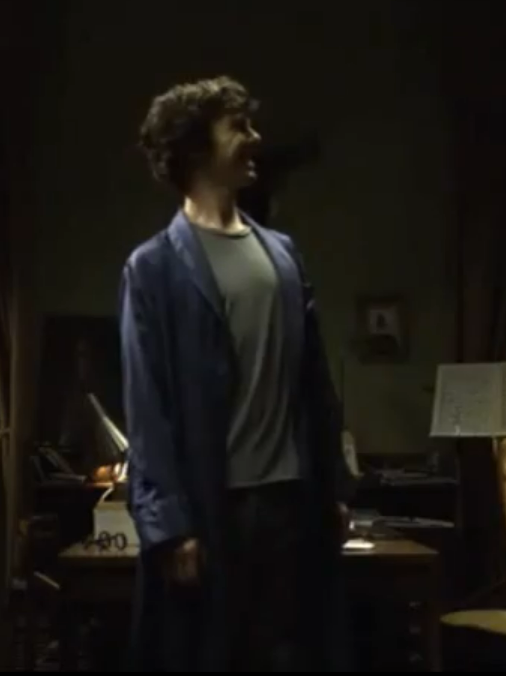
Oh my gosh, that scene where Sherlock just smiles like a proud little boy at his handiwork on the wall, reflecting that silly smiley face on the wallpaper, after being chastised by Mrs. Hudson, is priceless. :)
Now onto the nit-picking.
Unfortunately I am with the critics on the 2nd episode, "The Blind Banker" in terms of pacing and plot, including characterization.
While I appreciate the references to the dancing men, etc, I could not help find it a bit lackluster compared to the pilot which kept me at the edge of my seat. While the deductions of Sherlock were a thrill to watch, the rest of the plot fell a bit flat. It became too easy to predict the next move (like the death of Soo Lin was so predictable), unlike the pilot which still surprises me a little. The characters were also inconsistent (from a heroine to a damsel in distress, that Sarah). I don't know if it was a tongue-in-cheek kind of way to poke at the original canon's continuity errors.
I am still scratching my head till this day as to why a powerfully connected black market trading triad could get such a simple case of identity wrong. I mean, if this was 10 years ago and if the set was set in the 1800s, I think you could have played that trick on the audience. But with the availability of Internet in the show itself and their invisible game master not being an idiot, they should not have gotten John mistaken for Sherlock.
Also, they being Chinese doesn't make them ignorant to technology. After all, if people like Lukis and Van Coon were in their network, surely they'd have someone who is technologically savvy, or at least up to date with the who's who? Besides, have these writers not heard of Level: Asian? ;)
For now, I don't understand what is DI Dimmock's role, other than to look ridiculously smarted and dumb next to Sherlock. Well, in the canon, we've had silly inspectors who are slow in the brain works but lots of brawn. I guess this is what I missed in the series that was not reflected from the canons. Holmes always display his impatience with the Yard, but he only complains about their weaknesses to Watson, though he does praises some of their qualities. There are of course, some times when Holmes pointed out some flaws to the inspectors' faces, but then he really was too busy with the energy of the case to trifle with the slowness of his professional counterparts.
Sherlock displays his impatience really well, though I do believe Holmes has always been more genteel towards Watson because he cherishes Watson's friendship and loyalty. In the series, Sherlock does shows a more friendliness towards John, with his more chattiness when he's with him, and eventually a deeper affection for his friend (although I thought that was a little premature to be appearing in so early a season, but this isn't the canon where you can talk about 10 other different cases before friendships blossom).
Holmes is always courteous but curt. He doesn't apologize but he does show some respect to the tradition and culture of the society then. Maybe due to the series being a modern re-imagining, the culture of society now is less defined, more shades of grey. However, which brought me to the point, again in "The Blind Banker", as to how come Sherlock apologizes when he bumped into the European tourists when he was hot on scent? When Holmes is hot on a scent, he is not one to be distracted by social courtesies, unless he was in a disguise (which we haven't seen Sherlock done any yet!).
Another nit-picking with Sherlock was most probably he saying about "gardens with teddy bear" when he and John were arguing about the Solar System, a nod to "A Study In Scarlet". I don't think Holmes would ever say anything like that for an analogy. I mean, if he could go into a nonsensical but eloquent babble about a rose in "The Naval Treaty", I'm sure "gardens with teddy bears" could have been more eloquent.
I do find the constant references to Sherlock and John edging towards homosexual relations a little tiring. I mean, can't they just be good brothers who are affectionate towards each other but not in a sexual way? If the books could do it, why can't the series do it? I know it's the current culture of London and such, but I do find that this was one that need not be referenced over and over again. Like John's alleged brother who turned out to be his sister. Unless Harry will appear in the future episodes, can we not have the need to make up an excuse of why John does not want to depend on his relative or that to prove that Sherlock isn't always right? I thought him failing a case (which I would presently see it in the loose adaptation of Scandal in Bohemia for Season 2) would be more than suffice to highlight Sherlock's weaknesses. But it's just me. I do think the references could be less.
But again, I am nit-picking. Even though Episode 2 was not as fun as the pilot, "The Great Game" picked up the final leg of the first season with quite a bang. I still don't see how the Bruce-Partington plans has anything to do with Moriarty (though I do suspect that Sherlock has already passed the real stuff to his brother and brought a dummy one, because Sherlock isn't stupid. And he knows Moriarty isn't stupid either. Play the game of intellect my two dear archenemies), but with that enigmatic performance of Moriarty by Andrew Scott, I loved to see the cliffhanger end the season so well.
Onwards to Season 2!

Best part of the show was when Sherlock goes deep into thinking and this picture paints a thousand words from his mind
